
Chest Workout at Home: Common Questions Answered
A chest workout at home can be built around push-ups, dumbbell presses, or a combination of both. The useful question is how to choose movements you can perform consistently and make harder over time. This guide covers exercise selection, session planning, and progression without requiring a bench or an elaborate setup. Start with an exercise you can control and a workload you can repeat.
How should you structure a chest workout at home?
Start with a brief warm-up, choose one main pressing exercise, and add a second movement only if it serves a clear purpose. Perform the more demanding exercise first, rest between sets, and record your repetitions. Keep the session simple enough that you can repeat it and compare performance.
Have your mat, weights, and training log ready before starting. Prepare with an easier version of the movement you intend to perform, keeping those practice repetitions comfortable. The warm-up should help you rehearse your positioning without tiring you out. If you include two exercises, decide their order beforehand and keep that order consistent when comparing sessions.
How do you plan a chest workout at home without equipment?
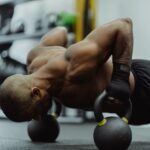
A chest workout at home without equipment can use wall push-ups, knee push-ups, or standard floor push-ups. Choose a version that lets you lower and press with control. Use a clear, nonslip surface, and end the set when you cannot complete another repetition without changing your body position.
Avoid treating every variation as an exercise you must include. Choose one starting version and note it in your log. For a floor push-up, move your torso as a unit instead of letting your chest and hips rise separately. If your position changes as you tire, finish the set rather than counting increasingly uneven repetitions.
What are the best chest exercises at home for your current ability?
The best chest exercises at home are pressing movements you can perform through a controlled, comfortable range and progress reliably. Wall push-ups suit someone who needs less resistance, while standard push-ups and dumbbell floor presses offer other options. Your equipment, movement control, and current strength determine the appropriate starting choice.
Judge your selection by the repetitions you can actually perform, rather than how demanding the exercise looks. If you repeatedly shorten the movement to finish, simplify it. Use a comfortable range you can reproduce throughout the set. Avoid changing your hand position, speed, and exercise variation all at once; that makes your starting choice harder to evaluate.
How can you organize a chest workout with dumbbells at home?
A chest workout with dumbbells at home can center on the floor press: lie on the floor with knees bent, hold the weights securely, and press upward under control. Lower until your upper arms gently contact the floor. Choose weights you can position and put down without struggling.
Clear the area before starting, avoid dropping weights, and check dumbbell fasteners according to the manufacturer’s instructions. Skip improvised benches made from furniture. Allow space beside you to place both weights down deliberately after the final repetition. Treat getting into position and finishing the set as part of the exercise, rather than rushing either step.
How many sets and repetitions should you start with?
Two working sets of one pressing exercise can provide a manageable starting session, with repetitions determined by the variation and your ability. Choose a difficulty that challenges you while leaving room for another controlled repetition. Record the result, then adjust future sessions according to performance and how well you recover.
For example, write down each set separately instead of recording only a session total. Next time, try to match those numbers with the same technique before adding work. Rest until you can repeat the movement with control. Rushing to meet a timer can make comparisons less useful, especially if the later set becomes a different movement.
How do you progress when your weights stay the same?
You can progress with fixed weights by adding controlled repetitions, using a more challenging push-up variation, or adding a set when your current workload is manageable. Change one variable at a time. Keep the movement and range consistent so that an apparent improvement reflects more work rather than looser technique.
Include a technique note, such as whether the last repetition stayed controlled. Progress does not need to occur every session. Repeating your performance with steadier positioning is useful information even when the repetition count stays unchanged. When you introduce a harder variation, record it as a new starting point rather than expecting your previous repetition count immediately.
Frequently Asked Questions
Can pressing exercises isolate the inner chest?
No pressing exercise exclusively isolates an “inner chest” muscle; the chest is not divided into independently trainable inner and outer muscles. Different movements can change the demands of an exercise, but squeezing your hands together does not guarantee a particular appearance. Focus on controlled training rather than promises of reshaping one narrow area.
Is a chest workout with dumbbells at home better than push-ups?
Dumbbell training is not automatically better than push-ups; it offers a different way to apply and adjust resistance. Dumbbells allow weight changes when you have suitable increments, while push-ups require no handheld weights. Choose the option you can perform, progress, and repeat consistently, or use both across your training schedule.
Can you compare push-up repetitions directly with floor press repetitions?
Push-up and floor press repetition counts are not directly interchangeable because the exercises use different setups and resistance. Keep a separate record for each movement instead of combining their repetitions into one score. Compare each exercise with its own previous sessions, noting the variation or dumbbell weight alongside the result.