
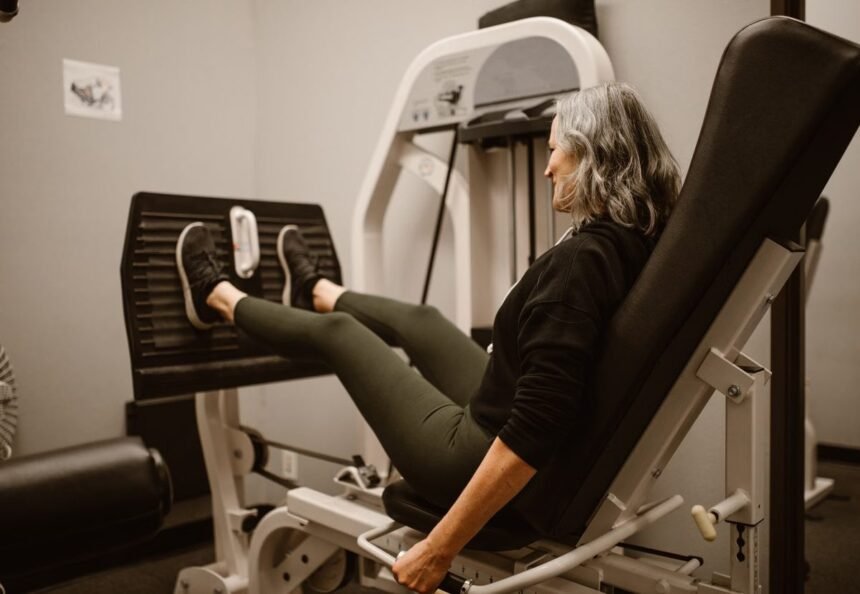
Understanding leg press form: A Guide to Proper Technique
Good leg press foot placement gives you a starting point for training your legs against resistance while your torso stays supported. Effective technique also depends on adjusting the machine choosing a load and controlling each repetition. Aim for a movement that keeps your hips supported throughout the set.Machines differ in their seat angles, safety mechanisms and movement paths.
Before adding weight read the instructions on your machine. Locate its stops and release handles. Ask gym staff to demonstrate controls.
What does proper leg press form look like?
Proper technique keeps your back and pelvis against the pads while your knees bend and straighten under control. Your feet remain firmly planted, and your knees travel in the same general direction as your toes. Finish with controlled knee extension, avoiding an abrupt snap backward or a bounce into the next repetition.
Your feet remain firmly planted and your knees travel in the general direction as your toes. Finish with controlled knee extension avoiding a snap backward or a bounce into the next repetition.Begin with a load and several practice repetitions. Adjust the seat so you can reach the starting position without rounding your lower or struggling to release the carriage.
How should you choose leg press foot placement?
Start with your feet around the middle of the platform, approximately hip to shoulder width apart, and toes turned slightly outward if comfortable. Adjust this position to accommodate your proportions and the machine. Keep your heels supported, maintain pressure through your whole foot, and let your knees follow your toe direction.
Adjust this position to accommodate your proportions and the machine. Keep your heels supported maintain pressure through your foot and let your knees follow your toe direction.This starting position is a reference, not a stance. Someone with thighs may need a different seat setting or foot position.
What are the main leg press muscles worked?
The main leg press muscles worked are the quadriceps at the front of the thighs, with the gluteal muscles also contributing to the push. Their relative contribution changes with joint positions and movement depth. The exercise involves both knee and hip extension, rather than isolating a single thigh muscle.
Their relative contribution changes with positions and movement depth. The exercise involves both knee and hip extension than isolating a single thigh muscle.Changing your stance does not switch muscles completely on or off. Prioritize a movement over trying to isolate one area through an unusual setup.
How deep should you lower the platform?
Lower the platform until you reach the deepest position you can control while keeping your pelvis and back supported. Stop before your hips roll away from the pad, your heels lift, or discomfort develops. A fixed knee angle is not a universal depth requirement across different bodies and machines.
A fixed knee angle is not a universal depth requirement across bodies and machines.Watch for your pelvis curling underneath you near the bottom. If this happens shorten the descent. Consider adjusting the seat according to the machines instructions.
Adding weight will not correct a position you cannot maintain with a load. Let your supported position determine where the descent ends.Use the safety stops where available following the manufacturers directions.
How much weight should you use?
Use a weight that lets you complete your planned repetitions with consistent depth, stable foot contact, and no bouncing. The final repetitions can feel challenging, but you should still control the descent and return. Reduce the load when maintaining the movement requires pushing on your knees or shifting your hips.
You should still control the descent and return. Reduce the load when maintaining the movement requires pushing on your knees or shifting your hips.For a practice session try a light set of eight to twelve controlled repetitions.
This is a learning range, not a requirement for every training goal.. Review your technique before adjusting resistance. End the set when fatigue prevents you from maintaining your intended movement.Stop if you experience pain rather than trying to work through it.
How should you track progress between workouts?
Track progress by recording the machine, seat setting, load, and repetitions after each session. Compare performances using the same equipment and setup whenever possible. Displayed weights are not directly comparable across machines because their mechanisms and carriage designs differ, so a larger number elsewhere does not necessarily represent progress.
Displayed weights are not directly comparable across machines because their mechanisms and carriage designs differ, so a larger number elsewhere does not necessarily represent progress.Include a note about whether you completed your planned range consistently. Use those observations to judge whether a load change is appropriate. A heavier set with shortened repetitions is difficult to compare with an earlier set performed through your intended range.Breathing out during the push and breathing in during the controlled return is an approach, for moderate practice sets.
Frequently Asked Questions
Should you breathe out while pushing?
Breathing out during the push and breathing in during the controlled return is a straightforward approach for moderate practice sets. Keep your torso steady throughout the repetition. If you need prolonged breath holding to move the weight, reduce the load while you develop control and learn the machine.
Can beginners use this machine?
Beginners can use the machine after learning its controls and practicing with minimal resistance. Rehearse entering the working position, releasing the carriage, and securing it again before attempting a challenging set. A trainer or gym staff member can supervise this practice and explain how the specific model operates.
Should you use the same settings every session?
Use the same settings when they continue to provide secure foot contact, supported hips, and comfortable movement. Treat your recorded setup as a starting reference when returning to familiar equipment. Recheck the adjustments before each session because another person may have changed them since your previous workout.