

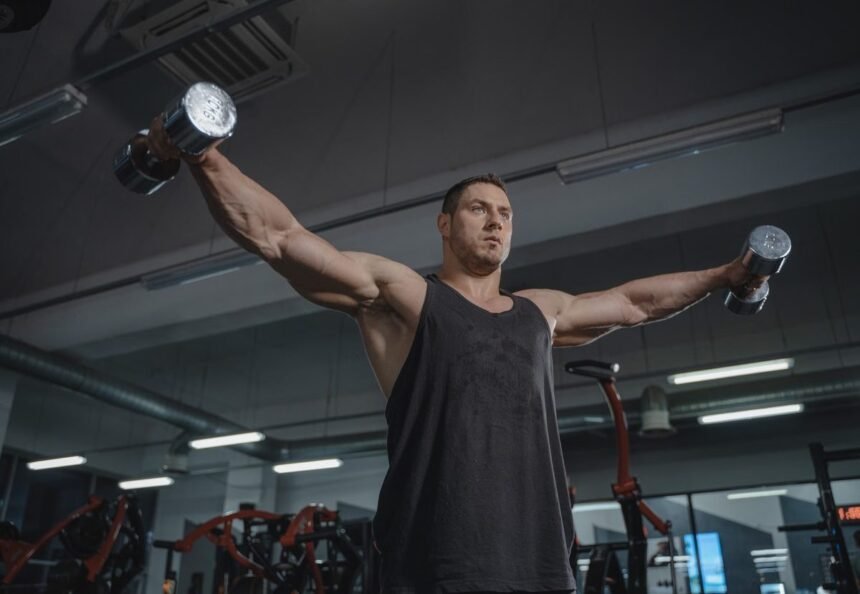
Rear Delt Workout FAQs: Dumbbell and Cable Exercises
Start your rear delt workout with a reverse fly or a rear delt row. If you plan to do both in the same session, put the movement you most want to improve first. Give yourself a few practice repetitions to find a setup you can reproduce before you start counting working reps.
The rear deltoids sit at the back of your shoulders and help move your upper arms outward from a position in front of you. During a fly or row, let your shoulder blades move naturally as you guide your upper arms through a comfortable range.
What are the best rear delt exercises?
Chest-supported dumbbell reverse flyes, cable reverse flyes, and rear delt rows are practical choices. In a reverse fly, your upper arms sweep outward while your elbows hold a slight bend. In a rear delt row, your elbows bend more as you draw your upper arms back and outward.
A chest-supported row is one of the best rear delt exercises to try if you find it hard to hold a steady torso during a bent-over row. Set your chest against an incline bench, let the dumbbells hang below your shoulders, and lead the pull with your elbows. Lower the weights until your arms hang freely again.
Watch for a change in elbow position near the end of the set. If your elbows begin to tuck toward your ribs as you tire, end the set and record the number of repetitions you completed with the intended arm path.
How do you do a rear delt workout with dumbbells?
For a rear delt workout with dumbbells, start with a chest-supported reverse fly. Lie face down against an incline bench with the weights hanging below your shoulders and a slight bend in your elbows. Sweep your upper arms outward to a comfortable height, then lower the weights under control.
Plant your feet and keep your chest against the pad as the weights rise. Your upper arms may come roughly in line with your torso. If you have to shrug or lift your chest to reach that point, finish the next rep a little lower. Aim to make the last rep look like the first.
Without a bench, hinge at your hips and soften your knees for a standing reverse fly. Start with the weights hanging beneath your shoulders. Keep the same torso angle as you raise and lower them, and reset your stance between sets if your balance shifts.
How do you do a rear delt workout with cables?
For a rear delt workout with cables, start with a single-arm reverse fly at about shoulder height. Stand sideways to the stack and grip the handle with your far hand. With that hand in front of your chest, sweep your upper arm outward while keeping your torso steady.
Keep a slight bend in your elbow as you guide the handle back. If the stack settles before your hand reaches the starting position, take a small step away from the tower and check the range again. If you have trouble staying steady, stagger your feet or rest your free hand against the tower.
With two pulleys, you can work both arms together by taking the left handle in your right hand and the right handle in your left. Before beginning the set, check that the cables clear each other and your arms throughout the movement. Record the pulley height, handle, and weight so you can reproduce the setup next time.
Sets, reps, and progression
Start with two sets of 12 to 15 repetitions on one exercise. Pick a load that lets you finish each set feeling as though you could do two more reps with the same arm path. If your first set reaches 15 but your second ends at 12, keep the load and work toward 15 on the second set over future sessions.
Once both sets reach 15 controlled reps, try the next available weight and build back up from the low end of the range. If the jump makes you shorten the movement or change your arm path, return to the previous load and add a rep or two before trying again. Write down the weight and completed reps after each set so you have a clear starting point for the next session.
For single-arm work, log each side separately. Start with the side that tends to get fewer controlled repetitions and match that number on the other side.
Frequently Asked Questions
Do regular rows train the rear delts?
Regular rows can train the rear delts, especially when your elbows travel outward as you pull. Rows with your elbows closer to your sides generally emphasize the lats more. To see which pattern you use in your current routine, watch where your elbows finish on a typical rep.
Can you train rear delts on back day?
Yes, you can train rear delts on back day by adding reverse flyes after your main rows or pulldowns. If rear delt work is a priority and your form consistently slips near the end of the session, move the fly earlier and see how that affects your other lifts.
Do you need both dumbbells and cables for rear delts?
One type of equipment is enough to train your rear delts. If you train at home with dumbbells, you can follow the dumbbell setup throughout your progression. If you already use a cable station at the gym, the single-arm fly works as your main exercise without a second fly variation.