
Hammer curls muscles worked, form, and grip variations
Check your hammer curls form on the last few reps of a set, when fatigue can make it harder to keep your palms facing inward and your torso still. The last rep you finish with the same technique you used at the start gives you a benchmark for your next set. Use that benchmark when you compare grips or decide whether to move up in weight.
Hammer curls form – How do you perform a clean rep?
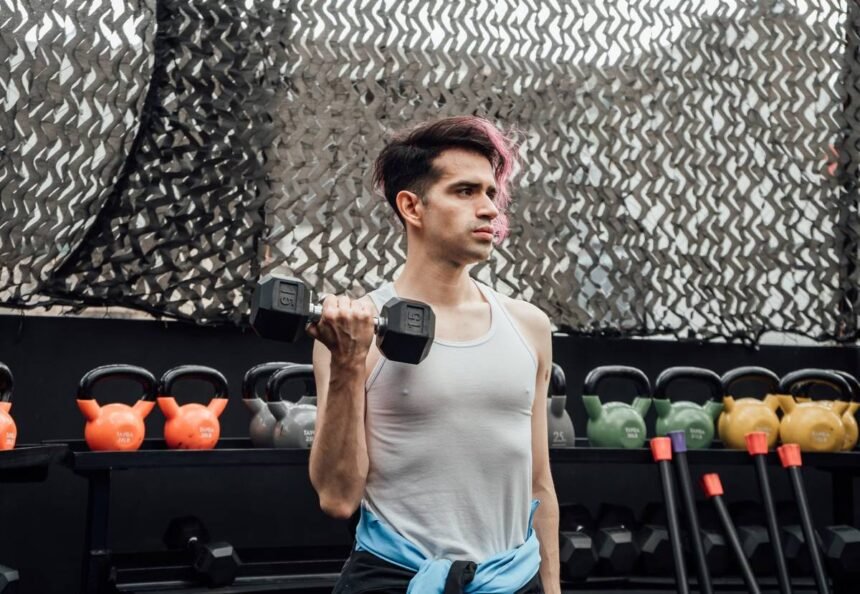
Curl the dumbbells with your palms facing inward, your wrists straight, and your upper arms close to your sides. Start with your arms hanging comfortably and bend your elbows to lift the weights. Stop before your shoulders roll forward, then lower the dumbbells until your arms are comfortably extended.
Pause briefly at the bottom so you can tell how the next rep starts. If your knees dip or your torso leans back before the weights move, reset and see whether you can start the lift from a still position. Watch for that change as the set gets harder.
If your elbows drift forward near the top, film one set from the side with your shoulder, elbow, and wrist in view. Watch where your upper arm starts to move. On the next set, use that point to judge where to end the lift before your shoulder has to help.
Hammer curls muscles worked – Which muscles bend the elbow?
The brachialis, biceps brachii, and brachioradialis help bend the elbow during a neutral-grip curl. The brachialis sits beneath the biceps, and the brachioradialis runs along the thumb side of the forearm. Your biceps contribute throughout the lift, while your grip keeps the dumbbell secure as you hold your wrist steady.
You may notice fatigue near the top of your forearm as the set goes on. That sensation tells you where you feel the effort, but it cannot tell you how much force each muscle produces. Your upper arm and forearm can both be working even if one area feels more tired.
With dumbbells, the lift often feels hardest when your forearm is roughly horizontal. In that position, the weight is farther from the vertical line through your elbow than it is near the bottom. Notice whether you start to speed up or change your wrist position as you pass through that part of the rep.
Hammer curls vs bicep curls – What changes with the grip?
Neutral-grip curls keep your palms facing inward, while standard biceps curls use a palms-up grip or rotate into one as you lift. Both movements bend the elbow. If you turn your palms up during the lift, the biceps help bend the elbow and rotate the forearm.
When comparing hammer curls vs bicep curls in your workout log, record the load and reps for each variation separately. You can keep the same rep target for both and choose a load you can control with each grip. Give each variation its own baseline for tracking progress over time.
If you already do palms-up curls, swap one of those sets for a neutral-grip set in the same place in your next workout. Keep your pace and rest similar so you can compare how the grips feel without also changing how tired you are when you start the set.
How should you choose a starting weight and progress it?
Start with a weight you can curl through a comfortable range with straight wrists and a steady torso. For example, try two sets of 8 to 12 reps and finish each set while you could still do another controlled rep or two. Increase the weight once both sets reach 12 clean reps.
Record each set separately. If you get 11 reps on the first set and nine on the second, keep the same dumbbells next time and aim to add a rep to either set. A total of 20 reps alone hides how close each set came to the upper end of the range.
Expect your rep count to drop when you move up in weight. If the heavier pair lets you complete fewer reps with the same technique, use that count as your new starting point. If you have to swing to finish the reps, return to the lighter pair.
Frequently Asked Questions
Can you do neutral-grip curls seated?
Yes, you can do neutral-grip curls seated on a bench with your feet flat on the floor. Let your arms hang at your sides and check that the dumbbells can clear your thighs. Sitting limits help from your legs and can make a backward lean easier to notice.
Should you curl both arms at once or alternate?
Curl both arms together to finish the set sooner, or alternate to focus on one side at a time. If you alternate, lower one dumbbell before lifting the other. Count reps per arm so you finish the set with the same number on each side.
How do cross-body curls change the movement?
Cross-body curls move the dumbbell diagonally toward the opposite side of your chest while keeping your palm facing inward. Your elbow still bends to lift the weight. Keep your shoulders facing forward and end the rep before you need to twist your torso or raise your shoulder.
Can you use a cable rope for neutral-grip curls?
Yes, you can do neutral-grip curls with a rope attached to a low pulley. Hold one end in each hand with your palms facing inward and step back far enough that the cable stays taut at the bottom. Your distance from the pulley changes the direction of the pull.